Bram Stoker
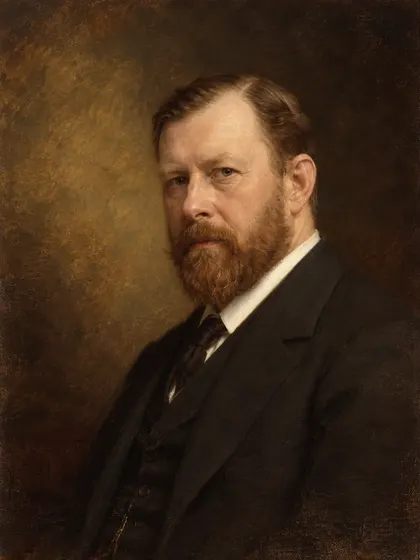
1847–1912
Documents, performance and the making of suspense
Bram Stoker was born in Clontarf, near Dublin, and studied at Trinity College. He worked in the civil service and as a drama critic before moving to London in 1878 to manage the actor Henry Irving’s affairs. His long theatrical career was central to his contemporary reputation. Dracula appeared in 1897; its later fame has often overshadowed the working life behind it.
Behind the books
A writer with another demanding career
Bram Stoker was born in Clontarf, near Dublin, in 1847. He attended Trinity College, worked in the civil service and reviewed theatre. In 1878 he married Florence Balcombe and moved to London to work for the actor Henry Irving. Managing Irving’s affairs and the Lyceum Theatre occupied much of his adult life.
It is useful to picture the author among schedules, correspondence and performances. Theatre depends on practical organisation as well as imaginative effect. Without treating Dracula as a disguised play, try noticing how Stoker arranges attention: an entrance matters, an absence can become alarming, and an ordinary room changes when someone sees what the others have missed.
This approach also keeps the author separate from his most famous creation. A fictional character’s commanding presence does not give us direct access to the writer’s personality. The more productive question is one of craft: how can a narrative make a person seem powerful even during long stretches when that person is scarcely visible?
Research, place and the making of Dracula
Stoker visited Whitby in 1890. Its harbour, churchyard and abbey ruins became part of the imaginative geography of Dracula. The contrast is still legible on the page: a recognisable seaside setting accommodates both daily routines and a growing sense that familiar explanations are failing.
Surviving working papers contain character lists, chapter plans and chronologies, alongside research on subjects including vampires, weather, shipwrecks and geography. They reveal a book assembled through planning and investigation. Dracula was published in 1897; its apparent immediacy rests on a carefully organised structure.
Think about the difference between a writer’s preparation and a character’s knowledge. Stoker can arrange connections that his characters have not yet discovered. A reader may suspect a pattern before any single participant has enough evidence to establish it. Suspense develops in that gap, even when the general nature of the threat is already familiar.
Place does more than supply a picturesque background. In your reading, follow thresholds: a room, a window, a doorway, a coast. Ask who can cross each one freely and who needs help or permission. This small exercise makes boundaries tangible without requiring every location to stand for one fixed symbolic meaning.
A reader’s orientation
Writing beyond the Count
Stoker also wrote other novels, short fiction and nonfiction. These examples sketch the range of his career; their inclusion does not imply availability in this collection.
The Snake’s Pass
This Irish setting provides a different starting point from Dracula. Approach it with questions about landscape and power: who describes a place, who claims it, and whose knowledge of it receives respect? Compare your expectations of adventure with the social relationships the story reveals.
Dracula
Letters, journals and other records divide the story among witnesses. Keep track of when an event happens and when someone learns about it. The resulting differences in knowledge can make a quiet exchange as tense as an openly threatening encounter.
The Jewel of Seven Stars
Another Gothic novel offers an opportunity to compare how Stoker builds uncertainty. Watch the confidence with which a character supplies an explanation, then distinguish that confidence from proof. The point is to test a reading habit, rather than assume every mystery follows the same pattern.
Personal Reminiscences of Henry Irving
Stoker’s account of Irving returns us to the theatrical world that occupied so much of his working life. A memoir invites different questions from a novel: how does closeness shape a portrait, and what does an admiring witness choose to preserve?
How suspense works on the page
A record is a viewpoint
A dated entry can feel reassuringly precise, but its writer still observes from a particular position. Separate what a document reports from what it concludes. A character may accurately record a disturbing detail while giving it an inadequate explanation. The reader’s unease grows because those two things need not agree.
Knowledge needs cooperation
Notice the work involved in collecting, arranging and sharing information. Separate experiences become more useful when people can compare them. Then ask who participates in that exchange and who is excluded. Protection can become a reason for withholding knowledge, creating a tension between care and another person’s ability to act.
The ordinary carries the strange
Travel arrangements and practical observations give the opening its texture. Resist the temptation to skim everything that does not yet look frightening. Such details establish expectations that later events can disturb. The familiar does not simply disappear when the supernatural arrives; it remains the standard against which the impossible is measured.
Meet the novel before the legend
When Stoker died in 1912, accounts of his life gave substantial attention to his theatrical career. Dracula’s later prominence can make that balance surprising. Familiarity with the Count, however, is an opportunity to compare what you expect with what the text actually chooses to show.
For a first reading, follow the witnesses and allow uncertainty to accumulate. On a return visit, choose one document and ask why it appears at that moment. What would change if it arrived earlier, or if another character described the same event? These questions turn a famous horror story into an absorbing study of timing, trust and the effort required to understand a shared danger.
Life and times
- 1847Born in Clontarf, near Dublin.
- 1878Moves to London to work with Henry Irving.
- 1897Dracula is published.
- 1912Dies; contemporary notices emphasize his theatrical career.
Historical context
Dracula belongs to the late nineteenth-century Gothic revival. Its diaries, letters and reports make the reader assemble events rather than receive a single continuous account. Modern habits of recording and communicating meet a threat that resists familiar explanations. The tension is not simply between an old world and a new one: the characters must decide which kinds of knowledge to trust.
An editorial reading companion
Read with a question
English text
Start with Dracula.
- Evidence: track what each document can establish and what its writer does not yet know.
- Cooperation: notice how separate observations become useful when shared.
- Atmosphere: watch the contrast between practical travel details and growing unease.
Reading notes
Jonathan Harker’s journal
The opening travel record gives routes, dates and ordinary observations before danger becomes clear. Those details establish a habit of documentation. As you read, separate what Harker observes from the explanations he initially gives it; the distance between the two helps create suspense.
OmniClassics editorial interpretation of the linked reading text. This is an introductory note, not a complete annotated edition.
Read the passage →