Herman Melville
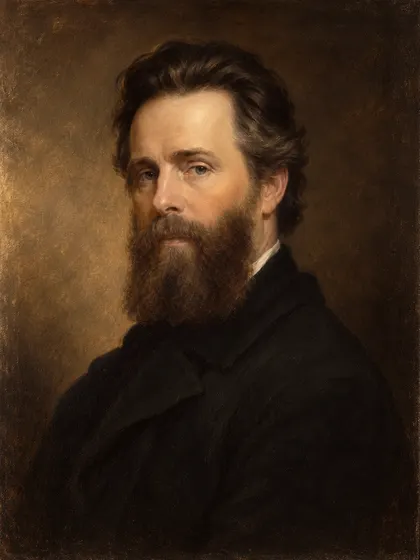
1819–1891
A working ship, an immense imaginative world
Herman Melville’s experience at sea helped shape his writing. In 1841 he sailed from New Bedford on the whaler Acushnet. Moby-Dick, published in 1851, transforms the world of whaling into a novel of extraordinary range. Shipboard work sits alongside comedy, argument and reflection; the practical and the speculative are rarely far apart.
Behind the books
An education beyond the classroom
Herman Melville was born in New York City in 1819. His father’s business failure and death disrupted a once comfortable childhood, and his schooling became intermittent. Before establishing himself as a writer, Melville tried work as a clerk and teacher. A merchant voyage to Liverpool in 1839 preceded the longer Pacific travels that would supply material for his early books.
Melville married Elizabeth Shaw in 1847. In 1850 he moved to the Berkshire countryside, where his friendship with Nathaniel Hawthorne became an important literary relationship. These changes place the writer in several different worlds: family responsibilities, the search for paid work, long voyages and the quieter labour of composition.
That range offers a useful invitation to readers. Try approaching Melville as a writer interested in how people learn when no single institution can teach them everything. A sailor may know something a philosopher overlooks; an apparently learned explanation may collapse under pressure. This is a reading question, rather than a claim that every fictional experience reproduces his life.
A ship is also a workplace
In January 1841 Melville sailed from New Bedford aboard the whaler Acushnet. New Bedford was then a leading centre of the whaling industry, with a busy waterfront serving ships, crews and trades. Melville learned the practical routines of whaling during his voyage. A decade later, writing in Pittsfield, Massachusetts, he transformed that experience into Moby-Dick.
Keep the working vessel in view while reading. The Pequod needs tools, supplies, skilled hands and cooperation. Its crew cannot survive on speeches alone. When a chapter describes a job, ask who performs it, what can go wrong and how one person depends on another. Those concrete questions make the novel’s larger arguments easier to feel.
The whale likewise moves between different kinds of attention. It is an animal, a source of valuable material, an object of study and a presence that characters interpret. You need not choose one meaning and discard the others. Much of the book’s energy comes from watching explanations compete for possession of something that exceeds them.
A reader’s orientation
A career that keeps changing direction
The following works show several entrances into Melville’s writing. These are literary introductions, not a list of titles available in this collection.
Typee and Omoo
These early books draw on Pacific travel and established Melville’s reputation. Consider how a traveller presents an unfamiliar society to readers at home. Who receives an explanation, who is allowed to explain themselves, and where does curiosity encounter an inherited prejudice?
Redburn and White-Jacket
Merchant service and naval life provide different shipboard settings. Read for the space between an institution’s official purpose and an individual’s experience within it. Routine can be as revealing as adventure when authority controls work, movement and the consequences of a mistake.
Moby-Dick
A whaling voyage becomes a meeting place for comedy, drama, practical description and speculation. Let its changes of form affect your pace. A chapter that seems to interrupt the chase may be changing the question you thought the chase would answer.
Pierre and The Confidence-Man
These later novels invite attention to uncertainty, interpretation and the risks of trusting appearances. A useful starting question is how readers decide that a voice deserves belief. Notice when your desire for a clear explanation becomes part of the reading experience.
Reading Moby-Dick without rushing the ocean
Listen for a change of voice
Ishmael can be companionable, scholarly, funny or speculative. Follow those changes before trying to reduce him to a single consistent attitude. Ask what each register makes possible: a joke may invite intimacy, a classification may promise order, and a theatrical speech may magnify a conflict beyond ordinary conversation.
Give the digressions a task
When the voyage seems to pause, choose one detail to carry forward. It might be a tool, an image of whiteness, a comparison between bodies or a remark about labour. Later, see whether that detail returns with a different force. You do not have to master every reference to notice the book teaching you new habits of attention.
Compare purposes
A captain’s purpose need not be shared by everyone working under him. Watch the distance between earning a living, seeking experience, maintaining order and pursuing an obsession. The danger becomes more tangible when you consider what happens to ordinary obligations under the pressure of one overpowering intention.
The writer beyond the famous whale
Melville later worked as a customs inspector in New York and devoted sustained attention to poetry. Battle-Pieces and Aspects of the War appeared in 1866; Clarel followed in 1876. He died in 1891. The broad revival of interest in his writing during the 1920s helped establish a reputation very different from his standing late in life.
Poetry makes a useful reminder that an author’s most familiar book is only one part of a working life. Return to the prose with your ear open to rhythm, repetition and pauses. Read a paragraph aloud, then ask where its momentum changes. Even amid technical detail, Melville’s sentences can make thought feel like an event unfolding before you.
Life and times
- 1841Sails on the Acushnet from New Bedford.
- 1851Moby-Dick is published.
Historical context
New Bedford was a major whaling port. Reading with that working world in mind helps explain why the novel devotes so much attention to tools, bodies and routines. Yet it is not simply a handbook: descriptions repeatedly become experiments in interpretation. The technical passages are part of the novel’s imaginative method, rather than obstacles placed between moments of adventure.
An editorial reading companion
Read with a question
Based on the first American edition (1851) · English text
Start with Moby-Dick; or, The Whale.
- Shared labour: notice how cooperation makes the ship function.
- Obsession: compare the purposes of individual sailors with the captain’s purpose.
- Ways of knowing: follow the shifts between observation, classification, speculation and story.
Reading notes
The material before “Loomings”
The Etymology and Extracts at the beginning gather words and references before Ishmael’s narrative takes over. They invite you to meet the whale through other people’s language first. You can read this as an early sign that no single description will contain the novel’s subject.
OmniClassics editorial interpretation of the linked reading text. This is an introductory note, not a complete annotated edition.
Read the passage →Where to start
- Moby-Dick; or, The Whale
For a capacious, surprising voice that turns a voyage into a whole way of seeing.