Jane Austen
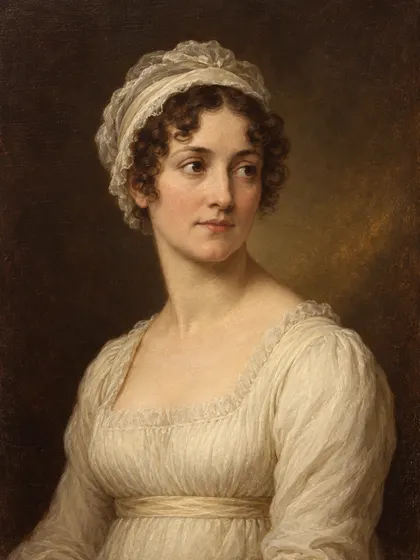
1775–1817
The extraordinary life of ordinary encounters
Jane Austen grew up in Steventon, Hampshire, in a family that enjoyed reading, writing and amateur theatre. Her fiction turns visits, conversations and family negotiations into occasions for examining judgment. After years in Bath and Southampton, she settled at Chawton in 1809. There she revised earlier novels and wrote new ones. Four novels appeared during her lifetime; Northanger Abbey and Persuasion followed after her death. The apparent smallness of her settings is deceptive: a drawing room can reveal a whole structure of social expectations.
Austen’s early world was rich in shared reading and performance. That background offers a useful way to approach the social energy of her fiction: a conversation is rarely just an exchange of information. It can be a performance for an audience, an attempt to gain an advantage, or a way of protecting feelings that cannot be stated openly.
The move to Chawton gave her a settled home during the years in which her novels reached print. Her career involved both returning to earlier writing and making new work. Reading with that process in mind helps resist the idea that these carefully shaped books are merely spontaneous records of country life. Their apparent ease is part of their craft.
Behind the books
A family, a home, a changing world
Austen was one of eight children. Her father, George, was a clergyman; her sister Cassandra remained a close companion throughout her life. After periods of schooling away from home, Jane continued learning within the family. Access to books mattered, but so did a household in which reading aloud, performance and jokes were shared pleasures.
The family moved to Bath in 1801. Her father’s death in 1805 reduced the income available to his widow and daughters, and a period of less settled accommodation followed. Chawton, where Austen moved in 1809, offered greater continuity. She lived there with her mother, Cassandra and their friend Martha Lloyd.
These circumstances help put the novels’ attention to homes in perspective. In Austen’s fiction, a house is more than scenery: it can mean security, dependence, exclusion or an uncertain future. A visit reveals who belongs comfortably and who must negotiate a place. Reading the domestic scenes with that question in mind brings their stakes into focus.
Becoming a novelist
Austen’s career was not a sudden arrival in print. Her early writings included parodies, short narratives and experiments in letters. First Impressions, an early form of Pride and Prejudice, dates from 1796–97. Elinor and Marianne preceded Sense and Sensibility; Susan developed into Northanger Abbey. The titles and revisions show a writer returning to her material over many years.
Sense and Sensibility appeared in 1811, followed by Pride and Prejudice in 1813 and Mansfield Park in 1814. Emma was published in December 1815 with an 1816 title-page date. Northanger Abbey and Persuasion appeared after her death, in late 1817 with 1818 title pages. Publication dates describe the books’ history, not necessarily the particular edition you are reading here.
Lady Susan, written as letters, and the unfinished The Watsons and Sanditon reveal other directions in her work. They are worth remembering alongside the six completed novels: a small surviving body of fiction can still contain a remarkable variety of forms. Austen died in Winchester in July 1817, aged forty-one; the precise cause of her final illness remains uncertain.
A reader’s orientation
Six novels, six different starting points
These brief editorial introductions describe the novels rather than a required reading order. Each offers a different balance of comedy, uncertainty and reflection.
Sense and Sensibility
Two sisters offer contrasting ways of meeting disappointment and managing feeling. Read for the tension between what can be expressed openly and what must be borne in silence. The title is a question to explore, rather than a simple instruction to choose one sister’s temperament.
Pride and Prejudice
Quick judgments, family pressures and the pleasure of conversation make this a lively introduction to Austen. The deeper interest lies in learning how to revise an opinion. Notice how readily wit persuades us to trust a speaker before we have examined the evidence.
Mansfield Park
A quieter viewpoint changes the experience of a crowded household. Watch the unequal freedom people have to speak, refuse or leave. For a reader willing to attend to hesitation and discomfort, social entertainment becomes a way of asking difficult questions about belonging and obligation.
Emma
Confidence in understanding other people becomes an absorbing source of comedy. Read it as an exercise in interpretation: separate what has actually happened from the explanations offered for it. Small details acquire new importance when you reconsider who first gave them meaning.
Northanger Abbey
Reading itself becomes part of the adventure. Expectations learned from stories can make ordinary encounters look wonderfully dramatic. Enjoy the playfulness, but also ask how someone with little experience is meant to distinguish a plausible explanation from an exciting one.
Persuasion
Time, memory and the possibility of change give this novel a different emotional rhythm. Attend to the distance between a person’s social visibility and their inner life. A restrained exchange can carry a history that the surrounding company does not understand.
How her fiction works
A voice close to a mind
One useful way to read Austen is to ask where a judgment comes from. A third-person sentence may move close to a character’s habits of thought without announcing a quotation. This technique, commonly called free indirect discourse, lets readers experience a viewpoint while still leaving room to question it. Being near a character is not the same as receiving a guarantee that the character is right.
Conversation as action
A dinner, a walk or a visit can alter a relationship without any dramatic announcement. Notice changes in address, interruptions and questions that receive no answer. Who gets to make a joke? Who has to pretend not to notice it? Austen gives these ordinary exchanges the weight that another kind of novel might give to a confrontation.
Money without a balance sheet
In Pride and Prejudice, the prospect of losing a family home gives urgency to conversations about marriage. Yet the novel does not reduce affection to a financial calculation. Its interest lies in the uncomfortable coexistence of desire, judgment and practical need. Compare characters’ choices before deciding that one rule can explain them all.
Reading twice
On a first reading, follow the people and enjoy the turns of the story. On a second, notice how your own attention was directed: a charming description, an incomplete report or a confident explanation may have shaped your expectations. The pleasure is not merely discovering a concealed answer. It is seeing how a convincing interpretation was made.
After Austen: reputation and reinvention
The novels published in Austen’s lifetime appeared anonymously. Her later reputation grew through republication, family biography and criticism rather than arriving fully formed. Richard Bentley’s editions in the 1830s brought the novels to new readers. James Edward Austen-Leigh’s nineteenth-century memoir helped establish a public image of his aunt, though a family portrait cannot tell us everything about a writer’s life.
Film and television have introduced successive audiences to her fiction, including the 1995 television Pride and Prejudice and the 2005 film. An adaptation gives faces, rooms and music to a story; a novel can keep us inside the uncertainty of a sentence. Returning to the text after watching a version is an opportunity to notice those differences, not a test of loyalty to one medium.
Our invitation is to read Austen as more than a collection of familiar romances. Try following an embarrassment, a change of mind or an unanswered question across several scenes. The distance between what people believe about themselves and what they reveal to others remains one of the richest reasons to keep reading her.
Life and times
- 1775Born in Steventon, Hampshire.
- 1809Moves to Chawton, her principal home during her publishing years.
- 1811Sense and Sensibility is published.
- 1813Pride and Prejudice is published.
- 1817Dies in Winchester.
Historical context
Austen’s working life crossed the Georgian and Regency periods. Her novels repeatedly ask how affection and independence operate within the pressures of property, family and social standing. In Pride and Prejudice, watch who can afford to dismiss a marriage proposal and who cannot. This is an editorial reading of the novel, not a claim that every character speaks for Austen.
An editorial reading companion
Read with a question
English text
Start with Pride and Prejudice.
- Judgment: keep track of the evidence behind an opinion, not just the confidence with which it is expressed.
- Money and marriage: compare the practical choices available to different characters.
- Narrative irony: ask when the narrator shares a social assumption and when the sentence quietly exposes it.
Reading beneath the conversation
In Pride and Prejudice, pay attention to the difference between what a character says and what the surrounding scene lets you infer. A compliment may establish rank; a polite question may conceal a demand. Rather than deciding immediately who is right, notice who controls the subject, who changes it, and who is left without a comfortable reply.
Elizabeth’s intelligence makes her an engaging companion, but sharing her viewpoint need not mean accepting every conclusion. Try keeping two questions in mind: what does she know at this moment, and what has the reader actually been shown? That small distinction makes the novel’s changes of understanding more rewarding without requiring advance knowledge of the plot.
A slower reading route
Begin with the opening exchange between Mr. and Mrs. Bennet. After reading it once for the joke, return to the practical concern underneath it: the daughters’ futures. Later, compare the way different households talk about marriage. The same subject can sound like romance, duty, security or opportunity depending on who is speaking.
On a second reading, follow the letters and reported conversations. Ask what becomes clearer when a speaker is absent, and what remains uncertain even after an explanation. These are editorial prompts, not a set of answers you must agree with; a good reading can test and challenge them.
Reading notes
The opening sentence: whose truth?
The first sentence sounds like a universal rule, but the next paragraph shifts attention to the families hoping to marry their daughters. Read the two together: the comedy comes from treating a local wish as an established fact. The opening is an invitation to question confident judgments throughout the novel.
OmniClassics editorial interpretation of the linked reading text. This is an introductory note, not a complete annotated edition.
Read the passage →Where to start
- Pride and Prejudice
For wit that rewards close attention, and a romance built around learning to look again.