Lewis Carroll
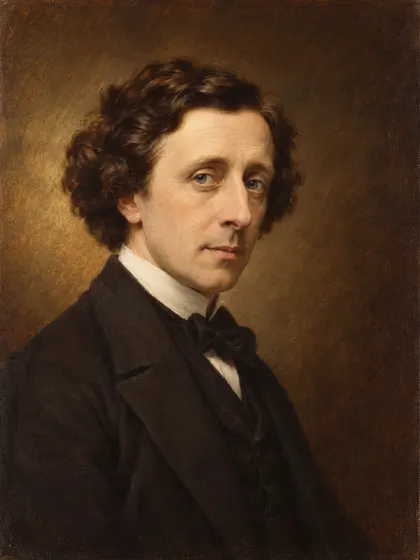
1832–1898
Curiosity at the edge of language and logic
Lewis Carroll was the pen name of Charles Lutwidge Dodgson. At Christ Church, Oxford, he studied mathematics and later taught it for twenty-five years. His interests included geometry, symbolic logic and photography. The Alice books belong alongside that broader life of experiments with representation, reasoning and play, rather than replacing it.
Behind the books
Charles Dodgson and Lewis Carroll
Lewis Carroll was the literary name of Charles Lutwidge Dodgson, who lived from 1832 to 1898. He entered Christ Church, Oxford, in 1851, gained a first-class degree in mathematics and became a mathematical lecturer in 1856. He held that teaching post for twenty-five years. Oxford was a long working environment, as well as the setting associated with the beginnings of Alice.
His interests included geometry, symbolic logic, voting systems and photography. The range matters because the stories were written by someone accustomed to thinking about rules, representations and the consequences of an apparently small distinction. It does not require us to turn every joke into a concealed equation. A conversation can be funny before we have decided whether it also illustrates a formal problem.
Consider the two names as part of one varied working life. The literary voice can make an argument wonderfully unstable; the mathematical work depends on determining what follows from a statement. Read with an ear for both possibilities. Sometimes a scene invites careful reasoning, and sometimes it exposes how little a confident speaker has actually established.
From a spoken story to a printed book
On a river outing in July 1862, Dodgson told a story to the Liddell sisters. Alice Liddell asked for it to be written down. He developed a manuscript, Alice’s Adventures under Ground, with his own illustrations, and presented it to her in 1864. The published Wonderland grew through expansion and revision, with illustrations by John Tenniel.
Alice’s Adventures in Wonderland appeared in 1865. The first printing was withdrawn after Tenniel objected to the reproduction of the pictures, and a replacement followed that year. Through the Looking-Glass appeared late in 1871 with an 1872 title page. These details remind us that a book reaches readers through drawing, printing and editorial decisions as well as sentences.
The movement from an outing’s entertainment to a carefully made object offers a useful way into the writing. Listen for a storyteller managing an audience: a sudden interruption, an unexpected reply, a question that seems easy until someone tries to answer it. Then notice how the printed page lets you stop and inspect a joke that spoken performance would carry past.
A reader’s orientation
A shelf of experiments
Alice’s Adventures in Wonderland
Begin here for the pleasure of encountering one impossible situation after another. Alice tries to apply familiar lessons and manners in circumstances that refuse to cooperate. Follow how she adjusts her expectations, and how often the effort to be reasonable puts her into a fresh difficulty.
Through the Looking-Glass
Mirrors and chess give the second Alice book a different organising imagination. Attend to directions, positions and reversals without expecting a diagram to account for every incident. The patterns can help you recognise connections while the encounters retain their strangeness.
The Hunting of the Snark
A quest becomes an opportunity to examine the language of certainty. Listen to the sound and movement of the verse, then ask what the expedition thinks it knows. The gap between elaborate preparation and an uncertain object gives readers plenty to consider.
The Game of Logic
This title belongs to Carroll’s work on reasoning. Placing it beside the fiction can prompt a useful distinction: an argument’s form and its subject are different things. In the stories, try asking whether a surprising conclusion follows from the premises or merely sounds convincing.
Small words, large disagreements
What did that sentence mean?
Carroll’s dialogue rewards attention to the exact wording of a reply. Two speakers may appear to share a subject while using a word in different senses. Before explaining a joke, read the exchange aloud. A pause or a stress can reveal the moment when an ordinary conversational expectation stops working.
Who is allowed to make a rule?
In Wonderland, instructions often arrive with great confidence. Separate the force of delivery from the quality of the reason offered. Alice must navigate not only curious claims but also the social difficulty of questioning someone who expects obedience. The comedy can feel familiar even when the speaker is a creature you could never meet.
Learning without a fixed lesson
Alice brings habits of recitation, classification and politeness into her adventures. Notice when those habits help and when they become awkward. Rather than extracting one moral from each scene, consider how the scene changes your sense of what a useful question would be. Uncertainty can be part of the pleasure of learning.
Read once for surprise, again for timing
On a first reading, allow the transitions to carry you. You do not need to solve every riddle to enjoy Alice’s persistence. On a second, follow one thread: changes of size, interruptions, questions about identity, or the difference between a command and an explanation. Repetition becomes easier to hear when you choose a small detail to follow.
Familiar images can make these books seem already known. Returning to the prose offers a different experience: you can watch the order in which a surprise is disclosed, or notice how a narrator prepares a joke. Let an adaptation or illustration be a starting point, then give the words time to create their own rhythm.
Life and times
- 1851Enters Christ Church, Oxford.
- 1856Begins his mathematical lectureship.
- 1898Dies, leaving literary, mathematical and photographic work.
Historical context
Carroll entered Christ Church in 1851 and became a mathematics lecturer in 1856. This intellectual setting is useful context, but it does not make every Wonderland episode a mathematical puzzle with one correct solution. The story also works through manners, misunderstandings and the instability of familiar words. Its pleasures include uncertainty as well as ingenuity.
An editorial reading companion
Read with a question
English reading text
Start with Alice's Adventures in Wonderland.
- Language: listen for speakers using the same word in different ways.
- Authority: ask whether a rule is reasonable or merely confidently announced.
- Identity: follow how Alice explains herself as her circumstances change.
Reading notes
The White Rabbit’s watch
Alice initially accepts a talking rabbit, then notices its waistcoat pocket and watch. The sequence matters: the narrator lets the ordinary and extraordinary overlap before curiosity takes charge. Read the opening slowly enough to notice exactly when Alice decides something is unusual.
OmniClassics editorial interpretation of the linked reading text. This is an introductory note, not a complete annotated edition.
Read the passage →Where to start
- Alice's Adventures in Wonderland
For playful dialogue and imaginative surprises that remain rewarding beyond childhood.