Mary Wollstonecraft Shelley
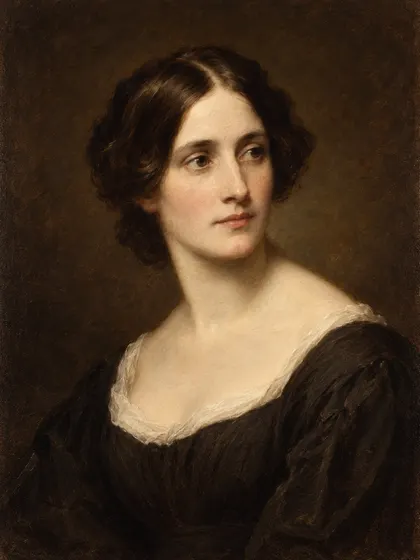
1797–1851
Creation, responsibility and the voices we choose to hear
Mary Shelley wrote fiction, biography and travel prose. Frankenstein became her best-known work, but her writing extends well beyond a single novel. Her interest in journeys and in lives shaped by loss gives readers useful ways into her fiction: characters move through landscapes while trying to make sense of their obligations to others.
Behind the books
A literary inheritance, an unsettled life
Mary Shelley was born Mary Godwin in London in 1797. Her parents were the writers Mary Wollstonecraft and William Godwin; her mother died shortly after her birth. Books formed part of her earliest environment. Her father’s library and her parents’ writings connected personal inheritance with arguments about education, justice and the organisation of society.
In 1814 she travelled to continental Europe with Percy Bysshe Shelley and her stepsister Claire Clairmont. Mary and Percy married in 1816. Their years together involved frequent moves, financial difficulty and the deaths of children. They settled in Italy in 1818; Percy drowned in 1822. Mary returned to England with their surviving son, Percy Florence, in 1823.
Knowing this history can sharpen our attention to the fragile households in her fiction. It should also leave room for invention. A fictional speaker’s grief is not a diary entry, and a character’s choices need not express the author’s beliefs. One rewarding approach is to consider how Shelley turns experiences of dependence, separation and care into situations that different readers can judge differently.
The work after the famous beginning
The summer gathering near Lake Geneva in 1816 supplied the setting for the ghost-story challenge associated with Frankenstein. Shelley later described a waking vision of a maker beside his creation. That account belongs to her retrospective introduction: it tells us how she presented the beginning of the book years after its composition.
Her professional life continued through novels, short fiction, reviews and biographical writing. She also edited Percy Shelley’s poetry, helping shape how later readers encountered his work. Writing was sustained employment as well as imaginative expression. Her career continued long after the young author of Frankenstein became a public story in her own right.
That wider career changes the questions we can bring to her. Instead of asking only where a single terrifying idea came from, we can ask how a writer revisits authority across different forms. Who has the right to tell another person’s life? What does a family owe its members? How can a story preserve someone without making their image fixed and complete?
A wider bookshelf
Different forms of belonging
Frankenstein
A creation story becomes a dispute over responsibility. Follow the movement between speakers before settling on a verdict. The novel gives its characters opportunities to explain themselves, while leaving readers to consider the difference between an explanation and an excuse.
Valperga
This historical novel turns to medieval Italy. A useful reading question is how public ambition affects people whose lives are treated as secondary. Look for the difference between describing political success and deciding whether its human cost can be justified.
The Last Man
A future devastated by plague makes survival an intimate as well as a collective question. Read for what happens to ordinary attachments when the future they assumed becomes uncertain. The prospect of an ending gives acts of companionship a different weight.
Rambles in Germany and Italy
Travel prose broadens the picture of Shelley’s interests. Try following the traveller’s attention: a journey is shaped by what someone pauses to describe. Compare the pace of looking outward with the more enclosed urgency of a fictional confession.
1818 and 1831: reading an edition carefully
Frankenstein first appeared anonymously in 1818. Shelley published a revised version in 1831, accompanied by the introduction describing its origins. These are distinct textual versions. A work’s first publication date does not by itself identify which wording an edition contains; consult the edition information alongside the reading text.
When comparing versions, begin with a manageable passage. Notice changes in how a speaker accounts for a decision, then consider whether those changes affect your judgment. Avoid assuming that every alteration points towards one simple message. Revision can modify emphasis, pacing and the relationship between an explanation and its surrounding scene.
Listening before judging
Follow the route of a story
Frankenstein begins with Walton’s letters and opens into other narratives. Keep track of who is speaking, who first heard the account, and how it reaches you. This need not become a test of whether every narrator is truthful. It is a way to notice that even a sincere story arrives through a particular person’s attention.
Distinguish sympathy from agreement
A persuasive description of suffering can make a character understandable without making every subsequent action defensible. Pause when you feel your allegiance change. Which detail changed it: a remembered kindness, a rejection, a claim about necessity? Shelley’s fiction becomes especially absorbing when compassion and judgment remain active together.
Return to the quiet scenes
After a first reading, revisit conversations about friendship, learning and home. Consider what each person expects from these ordinary bonds, and whether anyone asks what another person needs. The spectacular premise opens the door; the demands people make upon one another keep the moral questions unsettled.
Life and times
- 1818Frankenstein first appears.
- 1831A revised edition of Frankenstein appears.
Historical context
Frankenstein brings Gothic storytelling into conversation with questions about knowledge and responsibility. Its layered narratives make listening part of the moral problem. The novel first appeared in 1818 and was revised in 1831. Those versions should not be treated as interchangeable: introductions and narrative revisions can change the experience of a work.
An editorial reading companion
Read with a question
1831 edition · English text
Start with Frankenstein; Or, The Modern Prometheus.
- Responsibility: distinguish the desire to discover from the willingness to care for a discovery.
- Isolation: compare chosen solitude with exclusion imposed by others.
- Framed narratives: notice who reports each story, and whose words reach you indirectly.
Reading notes
Before Victor: the letters
The narrative begins through Walton’s correspondence rather than with Victor speaking directly to the reader. Keep that frame in mind as later voices arrive: a story told inside another story is also an act of selection. This note concerns narrative structure, not a claim that Walton’s account is automatically false.
OmniClassics editorial interpretation of the linked reading text. This is an introductory note, not a complete annotated edition.
Read the passage →Where to start
- Frankenstein; Or, The Modern Prometheus
For a Gothic story that gives its hardest questions more than one voice.