 A farewell to armsErnest Hemingway
OmniClassics · Literature
A farewell to arms
Ernest HemingwayA wartime romance asks what shelter two people can make within an unpredictable world.
Progress is saved in this browser
About the book
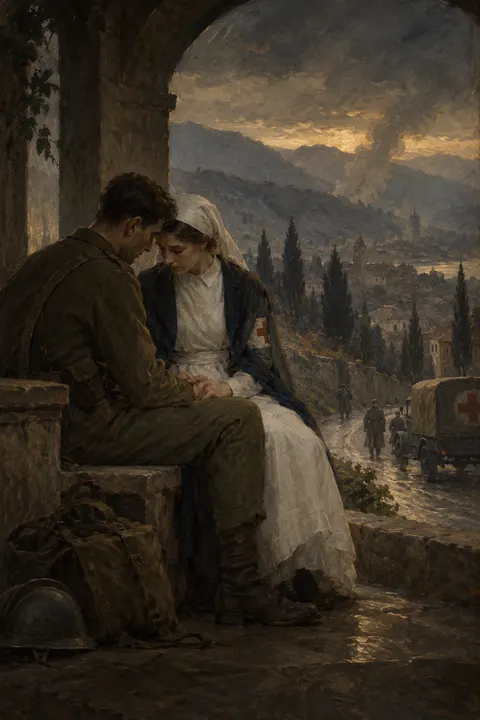
Frederic Henry, an American serving with an Italian ambulance unit during the First World War, meets the English nurse Catherine Barkley. Their developing relationship gives personal urgency to a life otherwise organised around military movement, injury, waiting, and routine. Hemingway keeps large declarations under pressure from concrete experiences: roads, hospital rooms, weather, meals, and conversations whose restraint can conceal intense feeling. As the war's demands become harder to reconcile with private attachment, Frederic must reconsider the obligations and assurances around him. The novel's emotional force depends on the effort to create a shared life without possessing control over its circumstances. Its spare surface invites attention to what the characters avoid saying, as well as to the moments when simple language carries more than an explanation could.
- Love and war
- Disillusionment
- Vulnerability
Why read it
For restrained prose that allows ordinary physical details and guarded conversations to carry the pressures of war and intimacy.
English text
Contents and reading sections
- Section 1
- Section 2
- Section 3
- Section 4
- Section 5
- Section 6
- Section 7
- Section 8
- Section 9
- Section 10
- Section 11
- Section 12
- Section 13
- Section 14
- Section 15
- Section 16
- Section 17
- Section 18
- Section 19
- Section 20
- Section 21
- Section 22
- Section 23
- Section 24
- Section 25
- Section 26
- Section 27
- Section 28
- Section 29
- Section 30
- Section 31
- Section 32
- Section 33
- Section 34
- Section 35
- Section 36
- Section 37
- Section 38
- Section 39
- Section 40
- Section 41