 Adventures of Huckleberry FinnMark Twain
OmniClassics · Literature
Adventures of Huckleberry Finn
Mark TwainA river journey unsettles the rules a boy has been taught to call right.
Progress is saved in this browser
About the book
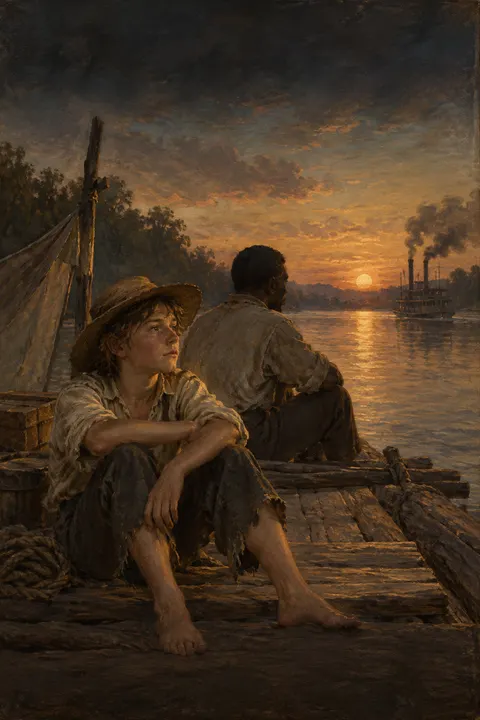
Huck Finn wants to escape both respectable supervision and the violence of his father. On the Mississippi he joins Jim, an enslaved man seeking freedom, and their journey exposes them to households, feuds, confidence tricks, and performances of social authority. Huck's account is immediate, observant, and limited by assumptions he has inherited from the people around him. Twain makes readers notice gaps between those assumptions and the humanity visible in Huck's encounters. The raft can offer companionship and temporary refuge, but the society on shore continually intrudes. Comic inventions sit beside an unsparing portrayal of slavery and racial prejudice. The central tension concerns whether Huck can act on his growing attachment to Jim when the moral vocabulary he has learned tells him otherwise.
- Freedom and slavery
- Conscience
- Friendship
Why read it
For a distinctive spoken voice that exposes contradictions its young narrator cannot always name.
English text
Contents and reading sections
- Section 1
- Section 2
- Section 3
- Section 4
- Section 5
- Section 6
- Section 7
- Section 8
- Section 9
- Section 10
- Section 11
- Section 12
- Section 13
- Section 14
- Section 15
- Section 16
- Section 17
- Section 18
- Section 19
- Section 20
- Section 21
- Section 22
- Section 23
- Section 24
- Section 25
- Section 26
- Section 27
- Section 28
- Section 29
- Section 30
- Section 31
- Section 32
- Section 33
- Section 34
- Section 35
- Section 36
- Section 37
- Section 38
- Section 39
- Section 40
- Section 41
- Section 42
- Section 43
- Section 44
- Section 45
- Section 46
- Section 47
- Section 48
- Section 49