 Aesop's Fables; a new translationAesop
OmniClassics · Literature
Aesop's Fables; a new translation
AesopAnimals and people reveal familiar habits through brief encounters whose consequences are difficult to evade.
Progress is saved in this browser
About the book
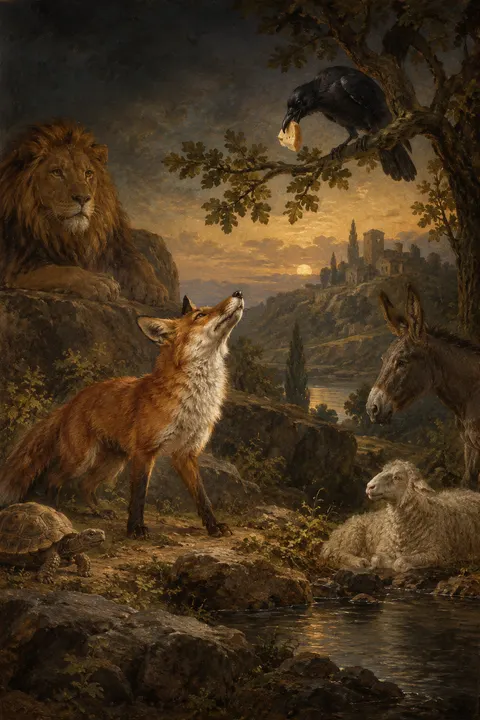
These fables compress conflict into a few actions: a creature boasts, bargains, imitates, trusts the wrong promise, or discovers the limits of its strength. Foxes, lions, wolves, birds, and human figures provide recognizable roles without requiring elaborate backgrounds. The simplicity allows a reversal or a pointed observation to carry much of the meaning. Some tales expose vanity and greed; others recommend caution, cooperation, or an accurate estimate of one's circumstances. Their lessons do not always form a single consistent philosophy, making comparison between stories rewarding. This version includes Chesterton's introduction and Vernon Jones's translation. Reading the collection as a sequence of small arguments reveals how a narrative can make practical wisdom memorable, while also inviting questions about whose interests a particular piece of advice serves.
- Practical wisdom
- Power and vulnerability
- Self-deception
Why read it
For compact stories that let a single action or reversal expose a habit, and invite readers to test the lesson it suggests.
Translated by V. S. Vernon Jones · introduction by G. K. Chesterton