 Five Weeks in a BalloonJules Verne
OmniClassics · Literature
Five Weeks in a Balloon
Jules VerneThree travellers attempt an African crossing by balloon, relying on a fragile combination of invention, judgment, and luck.
Progress is saved in this browser
About the book
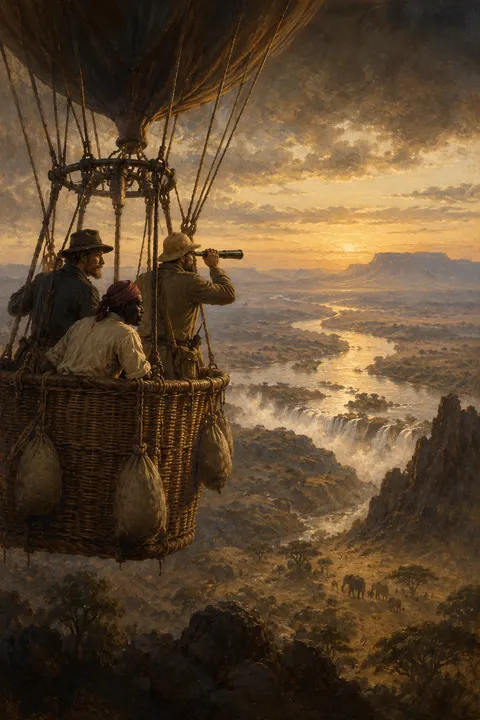
Doctor Ferguson proposes to link geographical discoveries through an aerial journey across Africa, accompanied by his friend Kennedy and his servant Joe. Their balloon offers an unusual vantage point and a means of crossing obstacles, but also makes wind, water, weight, and mechanical reliability urgent concerns. The travellers' different temperaments supply both disagreement and complementary skills as each new situation tests the plan. Verne combines geographical exposition with episodes of danger, using the imagined machine to turn a map into a sequence of practical problems. The narrative also carries the colonial assumptions and racial stereotypes of its European perspective. This translation is credited to the name William Lackland. The book's central attraction is the continual adjustment between a confident technological project and circumstances that refuse to become entirely predictable.
- Exploration
- Technology and uncertainty
- Companionship
Why read it
For an early Verne adventure built around the practical vulnerabilities of an ingenious means of travel.
Novel · English translation credited to William Lackland
Contents and reading sections
- Section 1
- Section 2
- Section 3
- Section 4
- Section 5
- Section 6
- Section 7
- Section 8
- Section 9
- Section 10
- Section 11
- Section 12
- Section 13
- Section 14
- Section 15
- Section 16
- Section 17
- Section 18
- Section 19
- Section 20
- Section 21
- Section 22
- Section 23
- Section 24
- Section 25
- Section 26
- Section 27
- Section 28
- Section 29
- Section 30
- Section 31
- Section 32
- Section 33
- Section 34
- Section 35
- Section 36
- Section 37
- Section 38
- Section 39
- Section 40
- Section 41
- Section 42
- Section 43
- Section 44
- Section 45
- Section 46