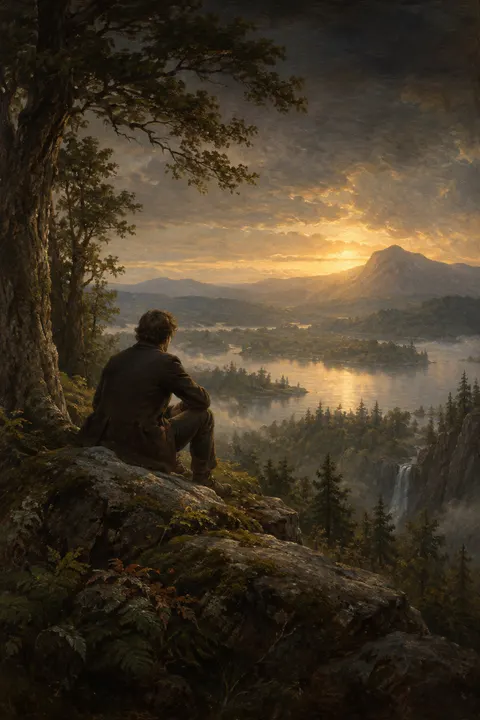
 NatureRalph Waldo Emerson
OmniClassics · Literature
Nature
Ralph Waldo EmersonEmerson asks what becomes possible when people encounter nature with their own eyes.
Progress is saved in this browser
About the book
Emerson begins by questioning why modern people should inherit their relation to the universe from earlier generations. His answer unfolds through an essay that treats the natural world as practical resource, source of beauty, language of thought, and discipline for the mind. Ordinary looking becomes an unusually ambitious activity: landscape can unsettle customary divisions between the observing self and what it observes. Chapters on idealism and spirit then press beyond description toward claims about reality, belief, and human renewal. The argument alternates philosophical assertion with vivid moments of perception, inviting both inspiration and resistance. This text preserves the 1849 new edition of the essay, whose compact scale contains a broad challenge to secondhand experience and intellectual dependence.
- Nature and perception
- Spiritual interpretation
- Intellectual independence
Why read it
Read it for the movement from a familiar landscape to radical questions about how experience becomes knowledge.
English text of the 1849 new edition