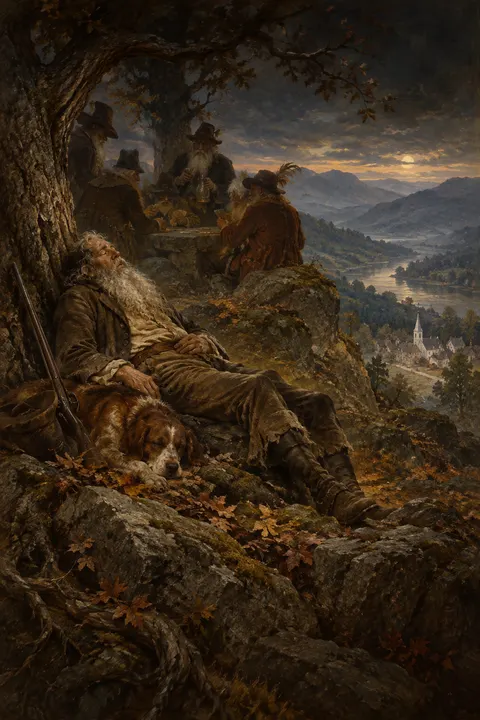
 Rip Van WinkleWashington Irving
OmniClassics · Literature
Rip Van Winkle
Washington IrvingA village idler's mountain excursion opens a comic gulf between personal memory and public history.
Progress is saved in this browser
About the book
Rip Van Winkle is generous with other people's errands but remarkably unsuccessful at managing his own farm and household. Seeking relief in the mountains with his dog, he encounters unfamiliar figures whose silent company carries him beyond ordinary village experience. What follows tests his ability to recognize the place, people, and political language he thought he knew. Irving frames the tale through the supposed papers of Diedrich Knickerbocker, giving its marvels the texture of local tradition and a narrator's playful uncertainty. The story's humor rests on more than Rip's indolence: private habits and communal memory prove curiously uneven measures of historical change. This separate English text comes from an edition associated with Arthur Rackham's illustrations, rather than the entire Sketch Book.
- Time and memory
- Community and identity
- Folklore and history
Why read it
The short tale turns a fantastic interruption into an affectionate, skeptical view of how communities remember their past.
English text from the Arthur Rackham edition