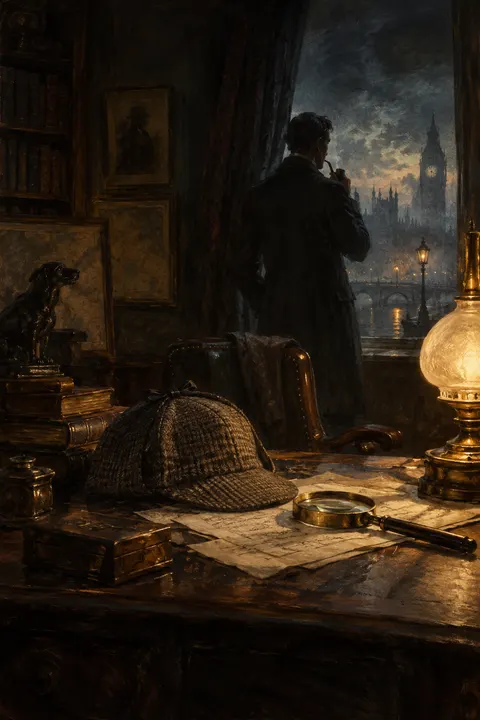
 The case-book of Sherlock HolmesArthur Conan Doyle
OmniClassics · Literature
The case-book of Sherlock Holmes
Arthur Conan DoyleThe final Holmes collection varies the voices through which the detective's work is seen.
Progress is saved in this browser
About the book
These cases return Sherlock Holmes to problems involving endangered reputations, puzzling behaviour, concealed histories, and apparently impossible events. Doyle also varies the narrative arrangement: Watson does not tell every story, giving readers opportunities to encounter familiar methods from a different position. Some investigations begin with suggestions of the grotesque or supernatural, while others depend on the ordinary dangers of jealousy, coercion, and greed. The shorter form gives each opening disturbance room to become a compact test of interpretation. Readers familiar with earlier collections can notice both continuities in the partnership and experiments in how its stories are presented. The volume's range makes it suitable for reading one case at a time, attending to the particular assumptions each mystery invites and then unsettles.
- Interpretation
- Hidden histories
- Narrative perspective
Why read it
For late Holmes cases that vary the familiar storytelling pattern while retaining the pleasures of close observation.
Short-story collection · English text
Contents and reading sections
- Section 1
- Section 2
- Section 3
- Section 4
- Section 5
- Section 6
- Section 7
- Section 8
- Section 9
- Section 10
- Section 11
- Section 12
- Section 13
- Section 14
- Section 15
- Section 16
- Section 17
- Section 18
- Section 19
- Section 20
- Section 21
- Section 22
- Section 23
- Section 24
- Section 25
- Section 26
- Section 27
- Section 28
- Section 29
- Section 30
- Section 31
- Section 32
- Section 33
- Section 34
- Section 35
- Section 36
- Section 37
- Section 38
- Section 39