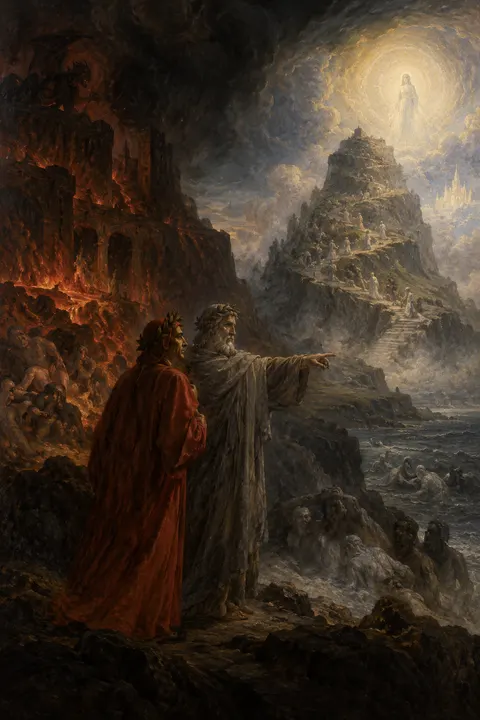
 The divine comedyDante Alighieri
OmniClassics · Literature
The divine comedy
Dante AlighieriA lost traveler journeys through the afterlife, encountering the moral consequences of human choices.
Progress is saved in this browser
About the book
Finding himself unable to escape a dark wood, Dante receives guidance from Virgil and begins a journey through Hell, Purgatory, and Paradise. The people he meets speak with vivid individual voices, bringing private loves, public rivalries, philosophical questions, and political grievances into a vast account of justice and spiritual transformation. The traveler's own responses matter: pity, fear, curiosity, and misunderstanding become part of what the journey must examine. Beatrice later provides a different kind of guidance as the poem's questions extend beyond the limits of human reason. This edition presents all three realms in H. F. Cary's English verse translation. Its movement joins an intensely personal crisis to an ordered universe whose inhabitants make the abstract structure emotionally immediate.
- Justice and responsibility
- Spiritual transformation
- Poetry and knowledge
Why read it
The poem's individual encounters give its immense theological and imaginative design a human urgency.
English verse translation by H. F. Cary, all three parts
Contents and reading sections
- Section 1
- Section 2
- Section 3
- Section 4
- Section 5
- Section 6
- Section 7
- Section 8
- Section 9
- Section 10
- Section 11
- Section 12
- Section 13
- Section 14
- Section 15
- Section 16
- Section 17
- Section 18
- Section 19
- Section 20
- Section 21
- Section 22
- Section 23
- Section 24
- Section 25
- Section 26
- Section 27
- Section 28
- Section 29
- Section 30
- Section 31
- Section 32
- Section 33
- Section 34
- Section 35
- Section 36
- Section 37
- Section 38
- Section 39
- Section 40
- Section 41
- Section 42
- Section 43
- Section 44
- Section 45
- Section 46
- Section 47
- Section 48
- Section 49
- Section 50
- Section 51
- Section 52