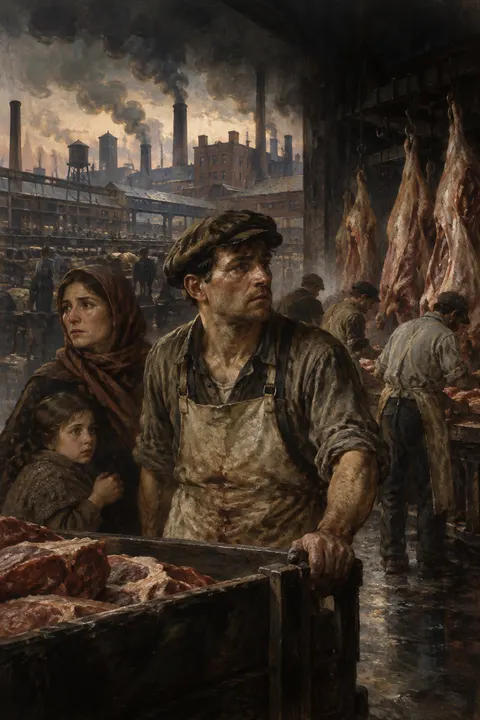
 The JungleUpton Sinclair
OmniClassics · Literature
The Jungle
Upton SinclairAn immigrant family's hopes meet an industrial system built to profit from their insecurity.
Progress is saved in this browser
About the book
Jurgis Rudkus and his family arrive in Chicago expecting hard work to provide a route towards stability. Employment in and around the meatpacking industry reveals conditions in which wages, housing, illness, injury, and political influence are closely connected. Sinclair follows the cumulative pressure of arrangements that can turn a small setback into a larger catastrophe. Domestic hopes give the account a personal centre, while the narrative increasingly argues for a political explanation of what the family experiences. The book's famous attention to food production belongs to a broader concern with the treatment of workers as expendable resources. Readers encounter both an urgent social novel and an explicit argument, whose power depends on tracing the distance between a promise of opportunity and the institutions controlling access to it.
- Labour
- Immigration
- Economic exploitation
Why read it
For the way a family's daily difficulties reveal connections among working conditions, housing, and political power.
English text
Contents and reading sections
- Section 1
- Section 2
- Section 3
- Section 4
- Section 5
- Section 6
- Section 7
- Section 8
- Section 9
- Section 10
- Section 11
- Section 12
- Section 13
- Section 14
- Section 15
- Section 16
- Section 17
- Section 18
- Section 19
- Section 20
- Section 21
- Section 22
- Section 23
- Section 24
- Section 25
- Section 26
- Section 27
- Section 28
- Section 29
- Section 30
- Section 31
- Section 32
- Section 33
- Section 34
- Section 35
- Section 36
- Section 37
- Section 38
- Section 39
- Section 40
- Section 41
- Section 42
- Section 43
- Section 44
- Section 45
- Section 46
- Section 47
- Section 48
- Section 49
- Section 50
- Section 51
- Section 52
- Section 53
- Section 54
- Section 55
- Section 56
- Section 57
- Section 58
- Section 59
- Section 60
- Section 61
- Section 62
- Section 63
- Section 64
- Section 65
- Section 66
- Section 67
- Section 68
- Section 69