 The Prince and the PauperMark Twain
OmniClassics · Literature
The Prince and the Pauper
Mark TwainTwo boys exchange clothes and discover how much the world believes in appearances.
Progress is saved in this browser
About the book
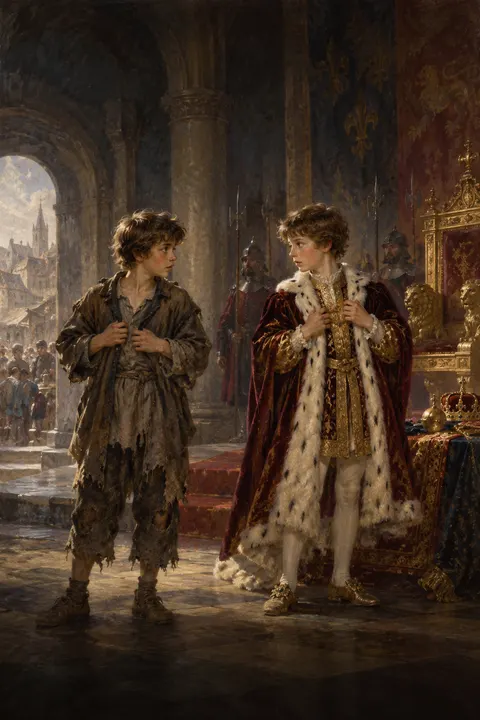
Tom Canty grows up in poverty while Edward Tudor lives surrounded by royal ceremony. Their striking resemblance makes a playful exchange of clothes possible, but the experiment soon separates each boy from the people prepared to recognise him. Twain follows the contrast between unfamiliar privilege and unfamiliar hardship, using mistaken identity to make social arrangements visible. A command that sounds authoritative in one costume becomes absurd in another, while customary punishment appears different to someone newly exposed to it. The adventure moves between courtly ritual and life outside its protection. Its central question concerns what rulers can know of the people they govern. The boys' changing circumstances make sympathy depend on experience rather than on assurances that the established order must be reasonable.
- Class and identity
- Justice
- Learning through experience
Why read it
For an accessible historical adventure that turns a playful premise into a pointed examination of power.
English text
Contents and reading sections
- Section 1
- Section 2
- Section 3
- Section 4
- Section 5
- Section 6
- Section 7
- Section 8
- Section 9
- Section 10
- Section 11
- Section 12
- Section 13
- Section 14
- Section 15
- Section 16
- Section 17
- Section 18
- Section 19
- Section 20
- Section 21
- Section 22
- Section 23
- Section 24
- Section 25
- Section 26
- Section 27
- Section 28
- Section 29
- Section 30
- Section 31
- Section 32
- Section 33
- Section 34