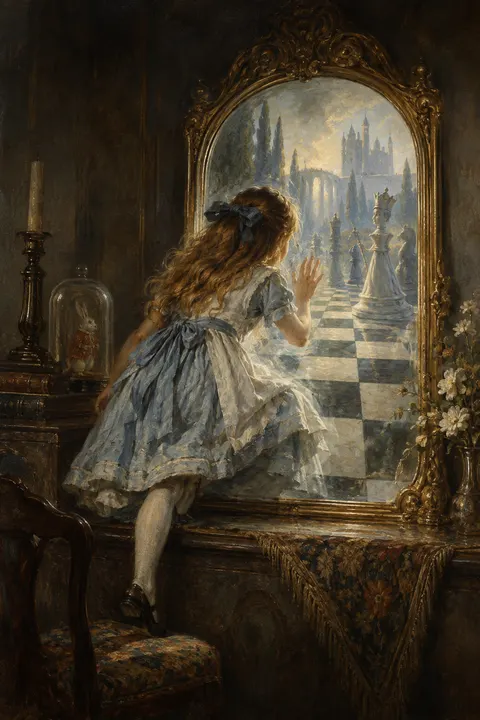
 Through the Looking-GlassLewis Carroll
OmniClassics · Literature
Through the Looking-Glass
Lewis CarrollA mirror opens onto a world where movement, meaning, and memory obey unfamiliar rules.
Progress is saved in this browser
About the book
Alice wonders about the room reflected in a mirror and enters a country organised in part like a chessboard. Her encounters with queens, talking flowers, nursery-rhyme figures, and argumentative companions repeatedly overturn ordinary expectations. Carroll gives the journey a different pattern from Wonderland, using crossings and transformations to connect episodes whose logic is often precise but delightfully misplaced. Poems interrupt conversation, words become objects of dispute, and explanations can make a problem harder to understand. Alice's persistence supplies continuity as identity and direction keep changing around her. The book is playful about authority without requiring its young traveller to become solemnly wise. It rewards rereading for the way verbal jokes and imaginative scenes make familiar habits of thought appear newly optional.
- Language
- Identity
- Rules and imagination
Why read it
For intricate verbal play and a dreamlike journey whose apparent nonsense often follows a remarkably exact logic.
English text