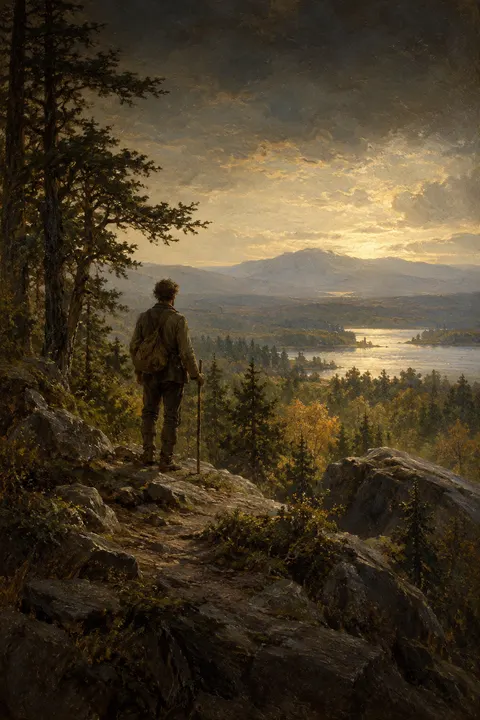
 WalkingHenry David Thoreau
OmniClassics · Literature
Walking
Henry David ThoreauWalking becomes a practice of attention and an argument for forms of freedom that cultivated society cannot fully provide.
Progress is saved in this browser
About the book
Thoreau distinguishes a serious walk from movement undertaken merely for exercise or a practical destination. To enter the landscape attentively requires a temporary release from business, domestic obligation, and habitual social concerns. His argument moves through fields, woods, swamps, property boundaries, language, literature, and the imaginative significance he assigns to the West. The essay's deliberately emphatic praise of wildness challenges the assumption that cultivation is always improvement. At the same time, its expanding geographical claims reveal the historical perspective from which the writer looks beyond his local surroundings. Readers encounter a meditation whose physical activity and intellectual movement continually reinforce one another, asking what becomes visible when a person stops treating every place as a possession, resource, or route towards somewhere already chosen.
- Wildness
- Attention
- Freedom and place
Why read it
For a concentrated argument that makes walking a way to examine the assumptions governing one's relation to landscape and society.
Essay · English text