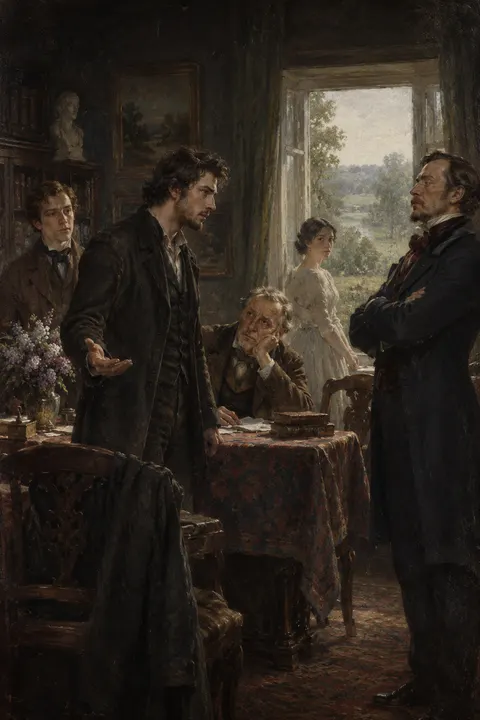
 Fathers and SonsIvan Sergeevich Turgenev
OmniClassics · Literature
Fathers and Sons
Ivan Sergeevich TurgenevA young man's radical convictions disturb a household whose affections and assumptions belong to an older generation.
Progress is saved in this browser
About the book
Arkady returns home with his friend Bazarov, a medical student who rejects inherited authorities and describes himself as a nihilist. Their arrival unsettles Arkady's father Nikolai and brings Bazarov into pointed conflict with his uncle Pavel. Arguments about art, science, social position, and useful work give the generational divide a visible language, but Turgenev also tests ideas through friendship, family attachment, and desire. Encounters with Anna Odintsova make emotional experience harder to contain within a confidently declared philosophy. The novel grants neither inherited gentility nor youthful negation an entirely secure position. Its intimate scale allows readers to watch public disagreements become personal vulnerabilities, as characters discover how much their chosen principles depend on feelings and relationships they have not fully understood.
- Generational conflict
- Conviction and feeling
- Family attachment
Why read it
For an intimate novel in which a celebrated conflict of ideas becomes inseparable from the characters' emotional exposure.
Novel · translated by C. J. Hogarth
Contents and reading sections
- Section 1
- Section 2
- Section 3
- Section 4
- Section 5
- Section 6
- Section 7
- Section 8
- Section 9
- Section 10
- Section 11
- Section 12
- Section 13
- Section 14
- Section 15
- Section 16
- Section 17
- Section 18
- Section 19
- Section 20
- Section 21
- Section 22
- Section 23
- Section 24
- Section 25
- Section 26
- Section 27
- Section 28
- Section 29
- Section 30
- Section 31
- Section 32
- Section 33
- Section 34
- Section 35
- Section 36
- Section 37
- Section 38
- Section 39
- Section 40