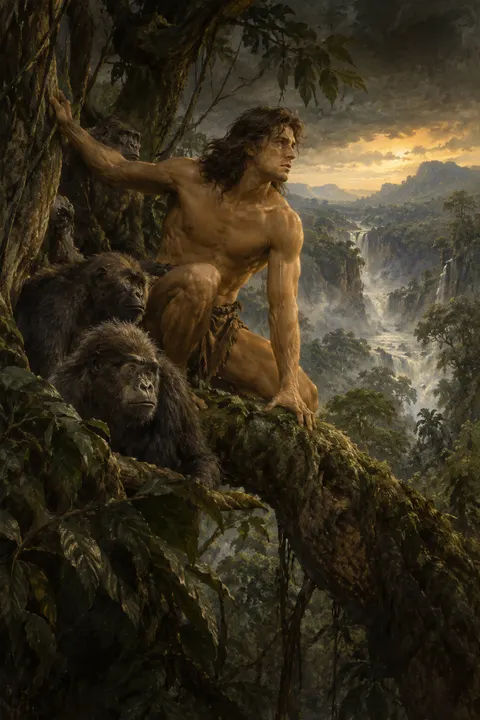
 Tarzan of the ApesEdgar Rice Burroughs
OmniClassics · Literature
Tarzan of the Apes
Edgar Rice BurroughsA child raised outside human society encounters the language, relationships, and inherited claims of the world from which he came.
Progress is saved in this browser
About the book
After his English parents are stranded on the African coast, their child grows up among apes, learning the skills and dangers of the forest. The possessions left in his parents' cabin offer another education, including a puzzling route towards written language. Encounters with human visitors, particularly Jane Porter, bring questions of belonging and identity into a life already shaped by physical contest and observation. Burroughs builds the adventure around the contrast between different forms of knowledge and the uncertainty of recognition. The novel's account of heredity and civilization is also structured by racial and colonial assumptions that materially shape its characters and judgments. Its narrative momentum comes from the collision between an upbringing outside conventional society and the social history that continues to make claims upon its protagonist.
- Identity and belonging
- Nature and education
- Recognition
Why read it
For the original adventure's interplay of physical resourcefulness, self-education, and an identity that others cannot readily recognize.
Adventure novel · English text
Contents and reading sections
- Section 1
- Section 2
- Section 3
- Section 4
- Section 5
- Section 6
- Section 7
- Section 8
- Section 9
- Section 10
- Section 11
- Section 12
- Section 13
- Section 14
- Section 15
- Section 16
- Section 17
- Section 18
- Section 19
- Section 20
- Section 21
- Section 22
- Section 23
- Section 24
- Section 25
- Section 26
- Section 27
- Section 28
- Section 29
- Section 30
- Section 31
- Section 32
- Section 33
- Section 34
- Section 35
- Section 36
- Section 37
- Section 38
- Section 39
- Section 40
- Section 41
- Section 42