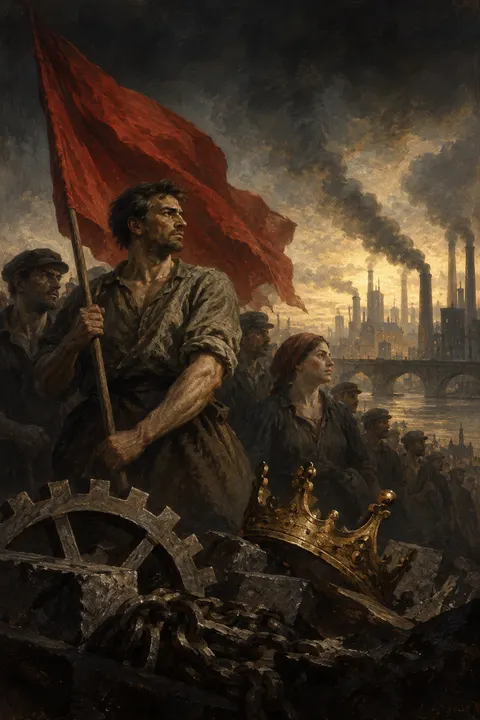
 The Communist ManifestoKarl Marx Friedrich Engels
OmniClassics · Literature
The Communist Manifesto
Karl Marx Friedrich EngelsA political manifesto interprets modern society through class conflict and collective action.
Progress is saved in this browser
About the book
Marx and Engels present an account of historical change centred on conflicts between social classes, then examine the transformations associated with the rise of the bourgeoisie. Their argument connects production, property, labour, and political authority, proposing that modern economic relations generate both new powers and new antagonisms. Later sections distinguish their position from other socialist currents and address relations with existing opposition movements. The text's compressed, declarative style belongs to its purpose as an intervention intended to persuade and organise. This reading follows the English edition of 1888 edited by Engels. Readers can examine the force of its historical model, the assumptions behind its predictions, and the relation between its diagnosis of society and its demand for political change.
- Class conflict
- Economic change
- Political organisation
Why read it
For a brief and influential argument whose historical claims and political rhetoric can be examined together.
1888 English edition edited by Friedrich Engels