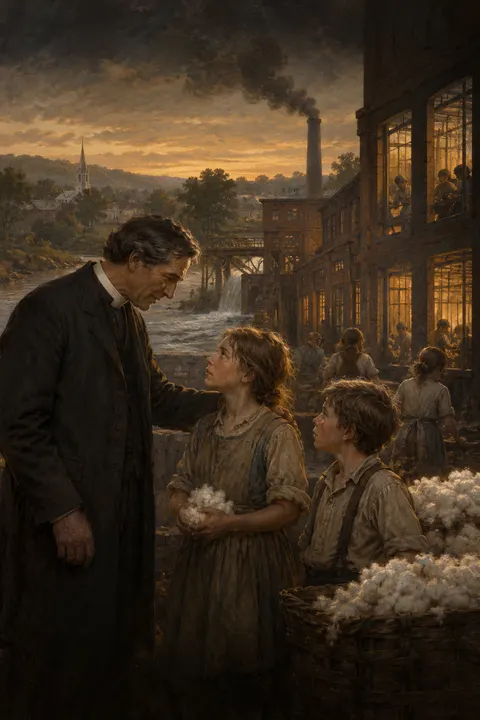
 The Bishop of Cottontown: A Story of the Southern Cotton MillsJohn Trotwood Moore
OmniClassics · Literature
The Bishop of Cottontown: A Story of the Southern Cotton Mills
John Trotwood MooreAn Alabama community's cotton economy brings industrial ambition into conflict with a preacher's belief in practical human kindness.
Progress is saved in this browser
About the book
In the Tennessee Valley, the world of plantations and thoroughbred horses gives way to the demands of cotton manufacturing. Richard Travis combines inherited position with a powerful role in the Acme Mills, while Hillard Watts, the preacher known as the Bishop, measures people by their capacity for kindness. Their surrounding community supplies intersecting stories of work, money, family, and moral obligation. The exploitation of children in the mills becomes a central test of what prosperity should mean and whom it should benefit. Moore arranges the novel's five parts around stages of cotton production, making the industry's material processes a framework for its human consequences. Its reforming concern for workers coexists with racial prejudice and an idealized account of the older plantation order.
- Child labor and industrial reform
- Practical faith
- Progress and inherited prejudice
Why read it
The cotton-production structure connects the novel's social argument to the labor and materials on which the community depends.
John C. Winston Company 1906 edition, illustrated by the Kinneys
Contents and reading sections
- Section 1
- Section 2
- Section 3
- Section 4
- Section 5
- Section 6
- Section 7
- Section 8
- Section 9
- Section 10
- Section 11
- Section 12
- Section 13
- Section 14
- Section 15
- Section 16
- Section 17
- Section 18
- Section 19
- Section 20
- Section 21
- Section 22
- Section 23
- Section 24
- Section 25
- Section 26
- Section 27
- Section 28
- Section 29
- Section 30
- Section 31
- Section 32
- Section 33
- Section 34
- Section 35
- Section 36
- Section 37
- Section 38
- Section 39
- Section 40
- Section 41
- Section 42
- Section 43
- Section 44
- Section 45
- Section 46
- Section 47
- Section 48
- Section 49
- Section 50
- Section 51
- Section 52
- Section 53
- Section 54
- Section 55
- Section 56
- Section 57
- Section 58
- Section 59
- Section 60
- Section 61
- Section 62
- Section 63
- Section 64
- Section 65
- Section 66
- Section 67
- Section 68
- Section 69
- Section 70
- Section 71
- Section 72
- Section 73