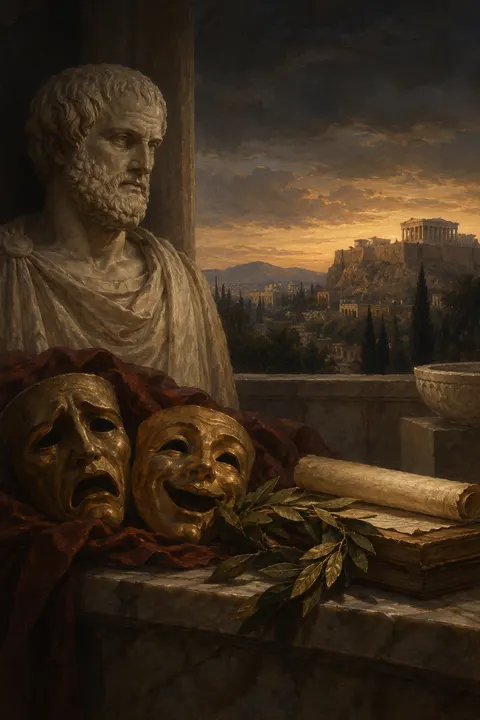
 The Poetics of AristotleAristotle
OmniClassics · Literature
The Poetics of Aristotle
AristotleAn inquiry into poetry asks how the arrangement of actions produces meaning and feeling.
Progress is saved in this browser
About the book
Aristotle examines forms of poetic representation, concentrating especially on tragedy and the features that make its action intelligible and affecting. Plot, character, language, recognition, reversal, and the relation between probability and necessity become parts of a practical vocabulary for describing artistic construction. The work does not read like a catalogue of universal rules detached from examples; it reasons through distinctions drawn from the literature and performance known to its author. Its compactness invites slow reading, particularly where a familiar critical term carries a more specific role in the argument. S. H. Butcher's English translation presents this influential inquiry into how a work becomes a whole. Readers can test its claims against stories they know while noticing where later expectations differ from its ancient frame of reference.
- Plot and form
- Representation
- Artistic effect
Why read it
For a compact set of questions that makes the construction of stories available to closer and more precise attention.
S. H. Butcher translation · English text