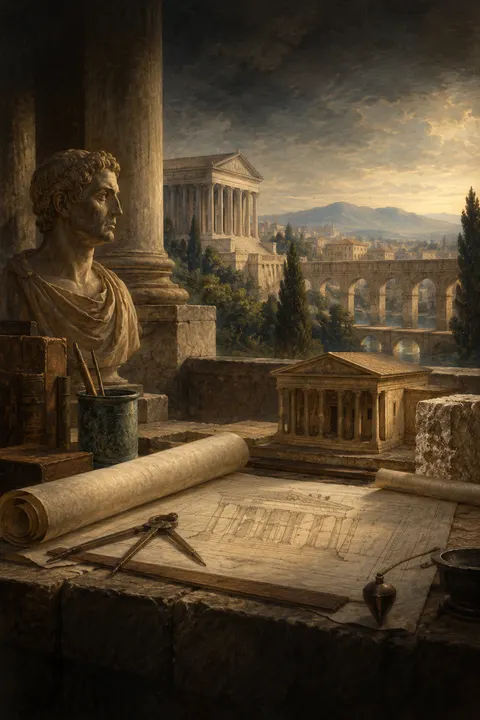
 The Ten Books on ArchitectureVitruvius Pollio
OmniClassics · Literature
The Ten Books on Architecture
Vitruvius PollioVitruvius presents architecture as a meeting of skilled practice, broad learning, and public responsibility.
Progress is saved in this browser
About the book
The architect imagined by Vitruvius needs much more than an ability to draw a handsome building. This treatise connects design to materials, site, proportion, health, water, machinery, and the many kinds of knowledge required to judge how a structure will function. Temples, public buildings, houses, and engineering devices appear within a common inquiry into sound construction and appropriate form. Explanations move between practical detail, inherited examples, and arguments about the architect's education. The 1914 English edition credits Morris Hicky Morgan's translation, while its preface explains that the final portion was completed after his death. Readers encounter an ancient technical worldview with its own assumptions and procedures, as well as principles that later architectural discussion repeatedly returned to and reinterpreted.
- Design and proportion
- Craft and knowledge
- Buildings and public life
Why read it
Its wide definition of architectural knowledge connects apparently separate questions of beauty, engineering, environment, and use.
1914 English edition of Morris Hicky Morgan's translation, completed after his death
Contents and reading sections
- Section 1
- Section 2
- Section 3
- Section 4
- Section 5
- Section 6
- Section 7
- Section 8
- Section 9
- Section 10
- Section 11
- Section 12
- Section 13
- Section 14
- Section 15
- Section 16
- Section 17
- Section 18
- Section 19
- Section 20
- Section 21
- Section 22
- Section 23
- Section 24
- Section 25
- Section 26
- Section 27
- Section 28
- Section 29
- Section 30
- Section 31
- Section 32
- Section 33
- Section 34
- Section 35
- Section 36
- Section 37
- Section 38
- Section 39
- Section 40
- Section 41
- Section 42
- Section 43
- Section 44
- Section 45
- Section 46
- Section 47
- Section 48
- Section 49
- Section 50