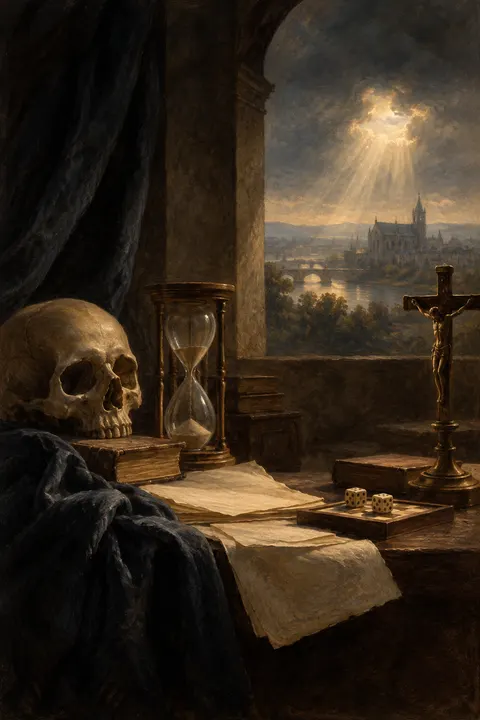
 Pascal's PenséesBlaise Pascal
OmniClassics · Literature
Pascal's Pensées
Blaise PascalPascal's fragments explore the restless distance between human ambition and human limitation.
Progress is saved in this browser
About the book
These thoughts, assembled from Pascal's unfinished writings, circle around a defense of Christianity without becoming a continuous, completed treatise. He examines the instability of human judgment, the desire for distraction, and the uncomfortable combination of greatness and misery in human life. Arguments about custom, reason, the heart, and religious belief appear beside compressed observations whose sharpness can interrupt the reader's own habits of thinking. The celebrated wager belongs to this wider inquiry rather than exhausting it. Because the work survives in fragments, connections must often be followed across gaps and changes of emphasis. This English edition includes an introduction by T. S. Eliot, adding another reader's account of the intellectual and spiritual pressures behind Pascal's prose.
- Human limitation
- Faith and reason
- Diversion and self-knowledge
Why read it
Pascal's unsettled form makes philosophical reading feel like an encounter with a mind still pressing its questions.
English text with an introduction by T. S. Eliot
Contents and reading sections
- Section 1
- Section 2
- Section 3
- Section 4
- Section 5
- Section 6
- Section 7
- Section 8
- Section 9
- Section 10
- Section 11
- Section 12
- Section 13
- Section 14
- Section 15
- Section 16
- Section 17
- Section 18
- Section 19
- Section 20
- Section 21
- Section 22
- Section 23
- Section 24
- Section 25
- Section 26
- Section 27
- Section 28
- Section 29
- Section 30
- Section 31
- Section 32
- Section 33
- Section 34
- Section 35
- Section 36
- Section 37
- Section 38
- Section 39
- Section 40
- Section 41
- Section 42
- Section 43
- Section 44
- Section 45
- Section 46
- Section 47
- Section 48
- Section 49
- Section 50
- Section 51
- Section 52
- Section 53
- Section 54