 TimaeusPlato
OmniClassics · Literature
Timaeus
PlatoA speculative account of the cosmos connects order in the universe with the constitution of living beings.
Progress is saved in this browser
About the book
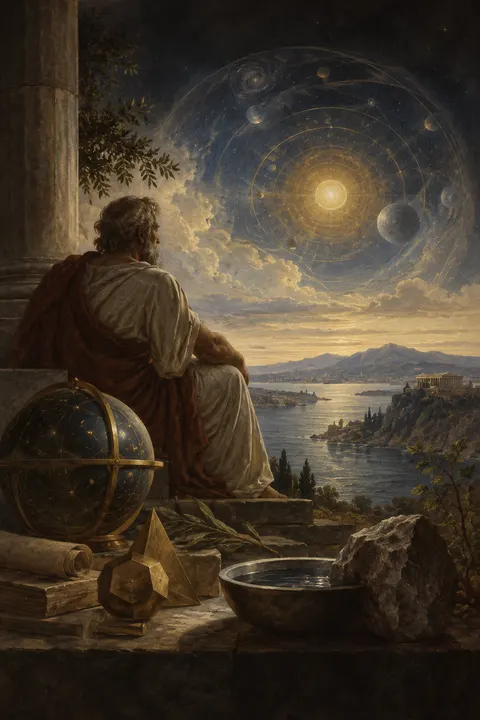
After an opening exchange that recalls questions of civic order, Timaeus offers an extensive account of the world's formation and structure. The discussion brings intelligence, necessity, mathematical proportion, soul, and bodily life into a single speculative undertaking. Its claims about the elements and the human organism belong to ancient cosmology rather than modern science, but the work's ambition exceeds a collection of physical explanations. It asks how an ordered world might be intelligible and how human life participates in that order. The speaker qualifies the kind of account available when discussing a changing universe, making the relation between explanation and certainty an important part of the reading. The dialogue invites attention to the imaginative architecture connecting ethical, mathematical, and natural questions that later traditions often separate.
- Cosmic order
- Explanation and probability
- Soul and body
Why read it
For a sweeping ancient cosmology that brings mathematics, nature, and the question of intelligible order into one speculative account.
English translation by Benjamin Jowett
Contents and reading sections
- Section 1
- Section 2
- Section 3
- Section 4
- Section 5
- Section 6
- Section 7
- Section 8
- Section 9
- Section 10
- Section 11
- Section 12
- Section 13
- Section 14
- Section 15
- Section 16
- Section 17
- Section 18
- Section 19
- Section 20
- Section 21
- Section 22
- Section 23
- Section 24
- Section 25
- Section 26
- Section 27
- Section 28
- Section 29
- Section 30
- Section 31
- Section 32
- Section 33
- Section 34
- Section 35
- Section 36
- Section 37
- Section 38