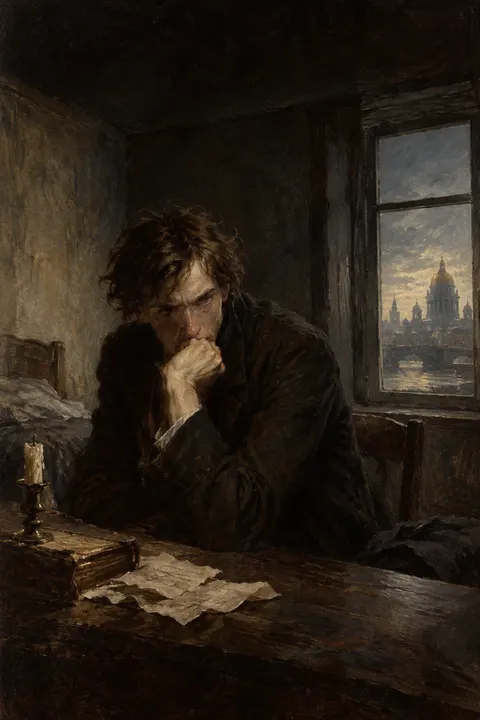
 Crime and PunishmentFyodor Dostoyevsky
OmniClassics · Literature
Crime and Punishment
Fyodor DostoyevskyAn extreme idea encounters the mind and relationships it cannot control.
Progress is saved in this browser
About the book
Raskolnikov lives in poverty in St Petersburg, increasingly absorbed by an argument about whether exceptional people may cross ordinary moral boundaries. A violent act turns that private theory into consequences he cannot keep at an intellectual distance. Dostoevsky follows feverish changes of thought, tense conversations, chance encounters, and relationships that alternately draw the young man towards others and deepen his isolation. The investigation is psychological as well as official: motives shift whenever someone tries to name them. Family sacrifice, material need, pride, and compassion complicate any simple explanation of conduct. The novel makes abstract reasoning feel physically and emotionally urgent, asking what happens when a person attempts to live as though an idea could release him from responsibility to other human beings.
- Guilt
- Ideas and responsibility
- Isolation
Why read it
For the intensity with which thought, conversation, and suspense become parts of the same moral struggle.
Constance Garnett translation · English text
Contents and reading sections
- Section 1
- Section 2
- Section 3
- Section 4
- Section 5
- Section 6
- Section 7
- Section 8
- Section 9
- Section 10
- Section 11
- Section 12
- Section 13
- Section 14
- Section 15
- Section 16
- Section 17
- Section 18
- Section 19
- Section 20
- Section 21
- Section 22
- Section 23
- Section 24
- Section 25
- Section 26
- Section 27
- Section 28
- Section 29
- Section 30
- Section 31
- Section 32
- Section 33
- Section 34
- Section 35
- Section 36
- Section 37
- Section 38
- Section 39
- Section 40
- Section 41
- Section 42
- Section 43
- Section 44
- Section 45
- Section 46
- Section 47
- Section 48
- Section 49
- Section 50
- Section 51
- Section 52
- Section 53
- Section 54
- Section 55
- Section 56
- Section 57
- Section 58
- Section 59
- Section 60
- Section 61
- Section 62
- Section 63
- Section 64
- Section 65
- Section 66
- Section 67
- Section 68
- Section 69
- Section 70
- Section 71
- Section 72
- Section 73
- Section 74
- Section 75
- Section 76
- Section 77
- Section 78
- Section 79
- Section 80
- Section 81
- Section 82
- Section 83
- Section 84
- Section 85
- Section 86
- Section 87
- Section 88
- Section 89
- Section 90
- Section 91
- Section 92
- Section 93
- Section 94
- Section 95
- Section 96
- Section 97