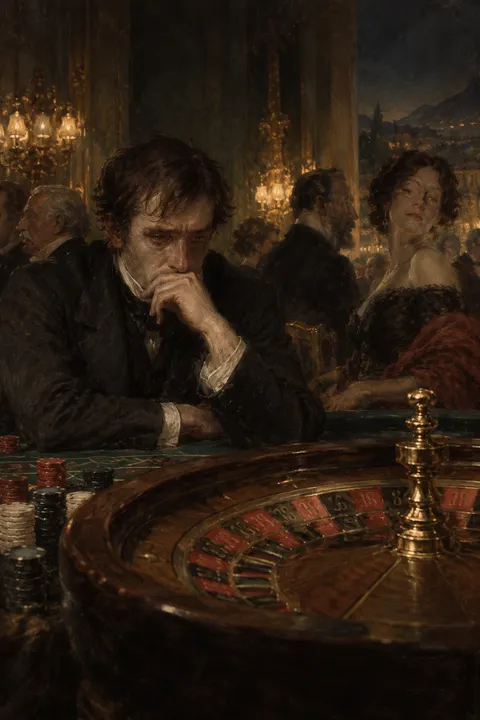
 The GamblerFyodor Dostoyevsky
OmniClassics · Literature
The Gambler
Fyodor DostoyevskyA tutor's uncertain position brings emotional dependence into the orbit of roulette.
Progress is saved in this browser
About the book
Returning to his employers in Roulettenberg, the narrator finds a household whose appearance of wealth rests on anxieties that everyone can feel but few will state plainly. Money, status, and his attachment to Polina make even an ordinary conversation a contest of interpretation. The gaming tables offer a more concentrated form of uncertainty, where a turn of fortune seems capable of changing everything at once. Dostoyevsky's first-person account allows excitement and humiliation to reshape the narrator's explanations as events unfold. The novel is interested in the difference between imagining freedom and becoming absorbed by a new form of dependence. Its sharp exchanges and sudden reversals make a short, intense study of a mind drawn toward the very instability it hopes to master.
- Chance and compulsion
- Money and status
- Emotional dependence
Why read it
For an urgent narrative in which the psychology of risk reaches beyond the casino into every relationship.
C. J. Hogarth English translation