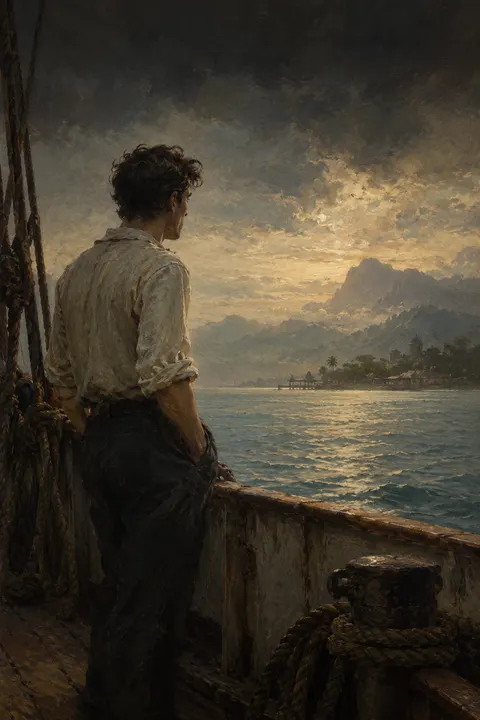
 Lord JimJoseph Conrad
OmniClassics · Literature
Lord Jim
Joseph ConradA sailor tries to live beyond the moment that contradicted his idea of himself.
Progress is saved in this browser
About the book
Jim has imagined a life of courage at sea, but an emergency aboard the Patna exposes a gulf between imagined heroism and action. The inquiry that follows gives his conduct a public meaning from which he struggles to escape. Marlow becomes interested in Jim and gradually assembles his story through conversation, observation, and other people's accounts. Conrad makes that indirect narration central to the novel: sympathy and judgment depend on evidence that never feels entirely complete. Jim's search for a fresh beginning carries the narrative into another community, where responsibility acquires new forms. The question is not simply whether one failure defines a person, but what it would mean to prove otherwise to oneself and to people who must rely on one's decisions.
- Honour and failure
- Judgment
- Second chances
Why read it
For a searching account of responsibility whose layered narration makes the reader participate in the difficulty of judging another person.
English text
Contents and reading sections
- Section 1
- Section 2
- Section 3
- Section 4
- Section 5
- Section 6
- Section 7
- Section 8
- Section 9
- Section 10
- Section 11
- Section 12
- Section 13
- Section 14
- Section 15
- Section 16
- Section 17
- Section 18
- Section 19
- Section 20
- Section 21
- Section 22
- Section 23
- Section 24
- Section 25
- Section 26
- Section 27
- Section 28
- Section 29
- Section 30
- Section 31
- Section 32
- Section 33
- Section 34
- Section 35
- Section 36
- Section 37
- Section 38
- Section 39
- Section 40
- Section 41
- Section 42
- Section 43
- Section 44
- Section 45
- Section 46
- Section 47
- Section 48
- Section 49
- Section 50
- Section 51
- Section 52
- Section 53
- Section 54
- Section 55
- Section 56
- Section 57
- Section 58
- Section 59
- Section 60
- Section 61