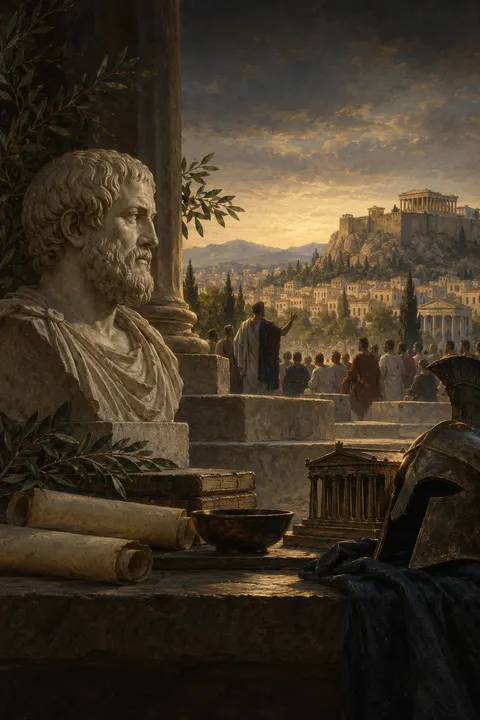
 Politics: A Treatise on GovernmentAristotle
OmniClassics · Literature
Politics: A Treatise on Government
AristotleThe purposes of a political community are examined through households, constitutions, conflict, and education.
Progress is saved in this browser
About the book
Aristotle asks what distinguishes a political community and what kinds of government can serve its purposes. Beginning with relationships within the household, he moves through citizenship, competing constitutional arrangements, the distribution of offices, and the causes of political instability. His comparisons give particular attention to how wealth, numbers, and rival claims to merit affect the exercise of power. The inquiry also reaches education and the conditions of a desirable civic life. Some of its premises, especially its defences of hierarchy and slavery, require critical attention rather than acceptance as neutral description. The work's continuing interest lies in the connections it draws between institutions and the people whose habits sustain them, asking how a constitution shapes conduct while also depending on material circumstances and established relations among its citizens.
- Citizenship
- Constitutions and power
- Civic education
Why read it
For an extensive ancient inquiry into the relationship between a community's institutions, social divisions, and conception of a good life.
English translation by William Ellis
Contents and reading sections
- Section 1
- Section 2
- Section 3
- Section 4
- Section 5
- Section 6
- Section 7
- Section 8
- Section 9
- Section 10
- Section 11
- Section 12
- Section 13
- Section 14
- Section 15
- Section 16
- Section 17
- Section 18
- Section 19
- Section 20
- Section 21
- Section 22
- Section 23
- Section 24
- Section 25
- Section 26
- Section 27
- Section 28
- Section 29
- Section 30
- Section 31
- Section 32
- Section 33
- Section 34
- Section 35
- Section 36
- Section 37
- Section 38
- Section 39
- Section 40
- Section 41
- Section 42
- Section 43
- Section 44
- Section 45
- Section 46
- Section 47
- Section 48
- Section 49